When evaluating a commercial or industrial roof asset, surface visual walk-throughs tell only half the story. A flat roof membrane can look completely sound, while thousands of square feet of underlying insulation boards are silently absorbing water.
For property managers and facility directors, trapped moisture is a hidden capital liability. It degrades building energy efficiency, causes deck corrosion, and leads to premature, full-scale roof replacements.
Using non-destructive thermal roof scans (infrared thermography), commercial asset managers can pinpoint trapped moisture before committing to major capital expenditures.
How Infrared Thermal Roof Scans Work
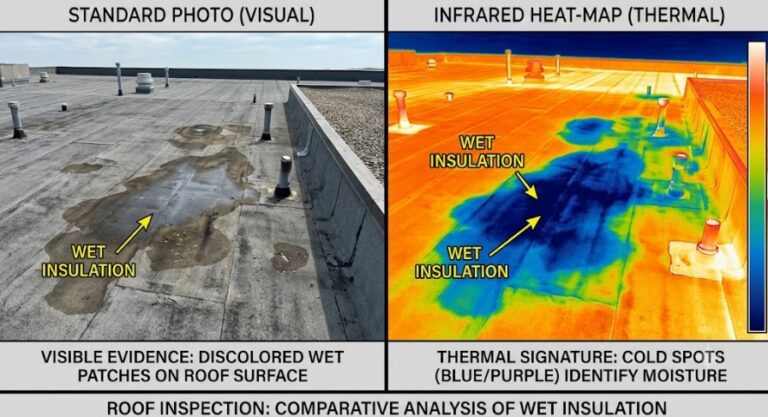
Infrared roof thermography relies on the scientific principle of thermal mass and capacitance.
During the day, the sun heats the entire commercial roof surface uniformly. When the sun sets, dry roofing materials radiate heat quickly into the night air. However, wet insulation holds onto solar heat far longer due to the high thermal capacity of water.
The Inspection Process:
- Timing the Survey:
Scans are performed at twilight or early evening as the building transitions into its cooling cycle. - Infrared Capture:
High-resolution thermal cameras (handheld or aerial drones) scan the membrane surface, converting emitted heat into a clear visual temperature map. - Moisture Verification:
Thermographers mark temperature anomalies and confirm saturation using capacitance moisture meters or targeted core samples.
The Financial ROI of Non-Destructive Diagnostics
Traditional roofing contractors often recommend a full roof tear-off the moment interior leaks become persistent. Non-destructive diagnostics shift facility management from reactive replacement to targeted preservation.
Inspection Factor
Surface Leaks Detected
Subsurface Water Detection
Cost Efficiency
Building Operations
Visual-Only Walkthrough
Visible cracks/punctures only
None (Requires cutting core samples)
High risk of over-replacing dry areas
Disruptive exploratory cuts
Infrared Thermal Scan
Traces water migration paths
Pinpoints exact wet insulation boundaries
Enables surgical 10–15% section repairs
100% Non-destructive & fast
Real-World Capital Savings
If a 50,000 sq. ft. warehouse roof is suspected of widespread failure, a thermal scan might reveal that only 12% of the insulation is saturated.
Instead of an immediate $150,000 full replacement, the property manager can execute a targeted $15,000 localized repair and apply a reflective restoration coating—extending the roof’s life by 10 to 15 years while saving over $100,000 in capital reserves.
When Should Property Managers Schedule a Thermal Inspection?
- Before Applying a Roof Coating:
Coating over wet insulation traps water forever, causing rapid blistering, deck rot, and catastrophic coating failure. - Prior to Real Estate Acquisition:
Include a thermal moisture survey in your Due Diligence (PCA) process to avoid inherited roof liabilities. - During Annual Capital Planning:
Track thermal performance trends to budget multi-year repairs accurately rather than handling unexpected emergency leaks.
Is Moisture Hiding Beneath Your Commercial Roof?
At Commercial Roof Assets, we utilize advanced non-destructive thermal imaging and moisture verification to help building owners protect their assets and extend roof lifespan.
Schedule a Non-Destructive Thermal Audit Today to inspect your property’s true condition.